How Does a B2B PR Agency Define Good Thought Leadership in the Age of AI?
Simply click and drag your
cursor over a passage of
text from the article below
to tweet or share.
Author: Ed Owen, PR Account Director at UMM
Key Takeaways:
- AI is revolutionising PR best practice, but overuse in thought leadership without human-led insight can produce less compelling brand narratives
- UMM, a B2B Sydney PR agency, explores what good thought leadership looks like in the age of AI, and the questions it needs to answer
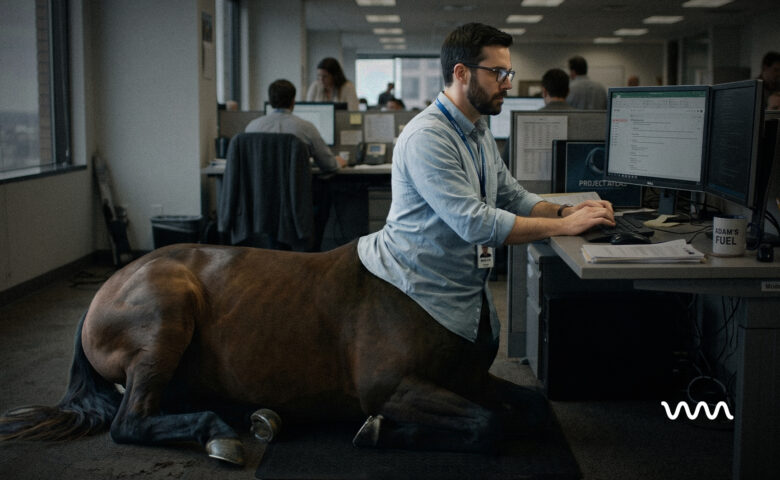
Have you heard of the reverse centaur? Please don’t click off this article, I promise I’m going somewhere with this.
The reason I bring it up is because of what it means for AI in PR. It’s especially important at a time when 84% of Australian workers are using at least one AI tool at work. In a world where AI is becoming embedded in all aspects of our lives, the spectre of the reverse centaur looms large.
OK, SO WHAT’S A REVERSE CENTAUR?
Glad you asked! The term was coined by journalist and sci-fi author Cory Doctorow, and builds off automation theory’s description of what a ‘centaur’ is. As Cory describes it, a centaur is a person who is assisted by a machine. If you’re driving a car, congratulations! You’re a centaur. You might not have hooves, but you’re a centaur nonetheless.
The reverse centaur flips this concept – a machine head on a human body. I know it’s an odd image, but what it’s doing is describing a fundamental readjustment in our relationship to the tools we use at work. Though a person is needed to operate the tool, the tool’s output is the focus.
In other words, you’re no longer driving the car – the car drives you. In some areas, this is clearly a good thing. AI has made time-consuming tasks like transcribing meetings a collective bad memory for PR professionals of a certain age.
That absolutely includes me, and I can’t tell you how envious I am of the latest generation of PR Execs. They haven’t spent their evenings typing up those meeting notes from scratch, parsing out hastily scrawled handwriting and playing back audio files.
But you know what? That’s a good thing. Yet the question remains – at what point is AI no longer enhancing best PR practice, but actively replacing it? And when this happens, what’s been lost?
View this post on Instagram
CRITICAL THOUGHT, CRITICALLY NEEDED
Now, I’ve burned through over 200 words to finally arrive at my point, or at least acknowledge the AI-shaped elephant in the room. While AI is invaluable in streamlining low-level tasks, it falls down when pondering some of PR’s fundamentals.
Namely, what makes a good story? What’s going to attract a journalist’s attention and appeal to their readership? AI isn’t really equipped to answer these questions. It doesn’t know why a particular story will land with a particular audience or reporter.
It’s not providing analysis and critical thought – it’s a predictive machine, putting one word in front of another to mirror patterns it’s seen elsewhere. And sometimes it gets it wrong…
View this post on Instagram
Without human-led expert insight, a PR strategy will fall short of its aims. So though AI might be able to churn out a whole host of stories for your brand, they can be generic or miss the mark. Quantity doesn’t equal quality, and this reverse centaur approach to thought leadership isn’t going to help you stand out.
If anything, it’s a recipe for annoying journalists. An active press office is only as good as its stories, and if you’re clogging inboxes with low-quality thought leadership, you’ve bought yourself a one-way ticket to the blacklist. I’m British, and I do like spam, but not like this.
STICKING TO THE BASICS
The good news is that we don’t have to overcomplicate things. High-quality thought leadership starts from a few fundamental questions:
- Who is this story trying to reach?
- Where is this audience taking in their news?
- Why does this story matter to them?
- What are these audience’s priorities?
These are the building blocks for any effective story. If these questions can’t be answered succinctly and without further caveats, more revision is needed.
And that’s the thing – it can take a while to align on these four questions. Good thought leadership takes skill, planning, and time, but if it’s built on solid foundations, good results will follow.
@media_first_ltd Honestly…🥹 #MemeCut #Meme #MemeCut #pr#publicrelations#comms#communications#worklife#workhumour#corporate#corporatehumor#corporatelife#fyp#trend#trending#media#journalist#broadcast#interviews#mftips ♬
THE MEDIUM IS THE MESSAGE
Once you’ve established these basics, it’s time to decide what shape your thought leadership will take. Knowing what content format best suits your story is vital to getting your message out there, and in this, context is key.
If you’re looking to position your brand as a trusted adviser, longer features and Q&As can give you the space to really emphasise this message. Do you have a suite of compelling products launching soon, and you want to get the message out far and wide? Press releases and comment opportunities are your friend.
If you’ve got excellent examples of your product or service in action, you might consider a case study. Whether as earned or owned media, case studies provide a strong platform for clearly explaining how you helped a customer, especially when presented in a clear, easy-to-follow format.
Consider two case studies we’d previously written for one of our clients, Logitech. In energy infrastructure leader ACCIONA and renewable energy business and power station operator Hydro Tasmania, the company had two strong examples of connecting workforces so they could communicate on-site and remotely, interstate and nationwide.
@nathandoancomedy Am I just writing bad prompts 😭 #skit #funny #comedy #chatgpt #ai ♬ original sound – Nathan Doan
But how would this look? And where would it sit? Lacking this context, AI’s recommendations can be muddled or misjudge what your audience wants. Leveraging expertise from agencies such as UMM will help you find the right medium, move the needle, and be the centaur you always wanted to be. Just me? Oh, okay.
KEEPING THE HUMAN ELEMENT
In the end, the reverse centaur is a reaffirmation of what good PR has always relied on – knowing how to package messages for target audiences and newsrooms. And sometimes, this involves putting a flesh-and-blood person in front of journalists.
After all, thought leadership isn’t limited to just words on a page. AI may have come a long way, but it cannot provide journalists with the assurance that the perspectives it offers are unmistakably human. Take UMM’s client, Dale Gillham, founder and CEO of Wealth Within, for instance.
Through a consistent PR strategy, Dale has built a recognisable voice within Australia’s finance landscape. Always nuanced and at times slightly contrarian, his commentary provides interpretation, not just information, which is critical in this AI era.
LEARNING TO TALK AGAIN
Even if you aren’t Dale, there are lessons to be learned from how he packages thought leadership for the media. Understanding what journalists want – new, interesting and emotionally resonant perspectives – is crucial to developing stances that are not just coherent, but compelling to boot.
But how to actually -talk- to a journalist is not something that comes naturally to most. Media training is another vital aspect of effective, human-led thought leadership, and we’re proud to offer it at UMM.
It was with this in mind that we recently organised a Media Engagement Workshop for Logitech’s Australian leadership team. Armed with the knowledge from this day, the team are now better prepared to dive into interviews and present themselves to journalists in the best possible light.
WISDOM IN CROWDS
Good thought leadership also doesn’t have to come from one person, especially on topics that spark debate. Yet where AI would look to homogenise these views into a generic whole, sometimes it’s better to embrace the full gamut of opinion. Developing panels that invite outside perspectives is a proven way to pique press interest.
And this is where the article comes full circle. As I write this, the dust is settling on Logitech’s latest LogiWork event, which took place in Sydney. With this latest showcase exploring the future of work, we organised a panel of Australia’s brightest minds in the AI space to debate how we can work smarter in 2026 and beyond.
We invited journalists to see real-time thought leadership in action, and the PR results are already evident. A number of interesting articles have already been published by journalists who attended. These articles offer unique insights that just aren’t possible with an AI-generated topic summary.
So while both a panel and AI thought leadership may be able to offer a round-up of a hot-button topic – in this case, AI’s role in the workplace – only the former can provide an organic and diverse range of opinions that would appeal to journalists and their readerships.
KEEPING AN OPEN MIND
Compelling thought leadership is driven by the biggest issues of the day and how they affect the world around us. But where AI would seek to simplify, something will inevitably be lost. On a tactical level, and in evaluating what will spark media conversations, experienced, human PR is more important than ever, if the reverse centaur is to be avoided.
That’s not to say AI should be avoided in PR. Used well, it can save time and free us up to take on more challenging and valuable work. But it can’t replace the human instinct that spots a narrative buried in raw information and turns it into a story worth telling. If you want a partner that will help you strike that balance, UMM is ready when you are. We’d love to have a chat.