In Memoriam: Facebook? Exploring Its Decline, Evolution and Relevance in 2026
Simply click and drag your
cursor over a passage of
text from the article below
to tweet or share.
We are gathered here to honour and celebrate the dear life of our friend, Facebook, a cherished social network for messaging, posting and, yes, at one point even “poking” each other for days on end. Now, more importantly, it helps us stay updated on Great Aunt Celia’s back garden (BTW, the tomatoes look great for this time of year).
Okay, maybe we’re being dramatic, but lately, it has earned the reputation as the internet’s retirement village: a place for Boomers to congregate and share every little detail of their lives while Gen Z and Millennials scroll elsewhere.
However, before we bury the platform in the grave of irrelevancy, it’s worth checking its pulse.
Rumours of Facebook’s demise are greatly exaggerated.
Approximately 70% of the Australian population is actively using it, making it the most widely used platform in the country. While apps like TikTok steal more of our daily attention with a reported 1 hour and 14 minutes, Facebook only trails by roughly 30 minutes at 46 minutes per day. That adds up to roughly five hours a week on the so-called “dying” platform: the same amount of time it takes to fly from Sydney to Fiji, watch two movies at the cinema, and run a half-marathon twice.
Sure, maybe there is some truth to the idea that Facebook’s most active users skew older, with the average 18-24-year-old using it ten minutes less than the average user. In Australia, this age group comprises 3.5M of the userbase, following 25-39-year-olds at 6.3M users and 40-55-year-olds at 4.3M. Still, younger users remain on Facebook—interacting, liking, messaging, and reacting, contributing to a platform that sees nearly half of the Australian population logging in daily.
Across comment sections on TikTok and Reddit, a consensus has formed: Facebook is less about going viral and more about community. It’s where people keep up with friends and family, join community groups, and organise or scout for local events.
@joeefoster I will be 80 years old and still in a Facebook group from my uni days if it’s still going I loooooove them so much #facebook #facebookmarketplace #gossip #tea ♬ Stupid thief’s stealthy steps [Comedy-style drama accompaniment] (991302) – SoLaTiDo
So, how are people using Facebook now?
You see it in flatshare groups, in neighbourhood forums, in niche communities dedicated to everything from “approving corgi” photos and advice columns, and even to events as peculiar as “blowing at Cyclone Alfred to push it back”. And of course, we can’t forget Facebook Marketplace, a digital marketplace that feels like a modern-day yard sale.
It’s this culture of hyper-specific community-building that brands can tap into too—we leaned into it ourselves in 2024, launching a Fairy Bread Fan Club to rally fans around Fairy Bread Day (read more here).
Notably, Facebook is the most used platform by marketers in 2025, generating just over almost $275 million AUD in ad revenue. Perhaps it’s because it’s the second most popular platform for product discovery, or maybe it’s that Facebook consistently delivers genuine results (with an average click-through-rate of 2.53% and conversion rate of 8.78%).
One thing is for sure: Facebook remains a powerful marketing tool, helping brands form and build communities, generate impressions, and drive engagement, all while being easy to manage and measure through the sophisticated Meta Business Suite.
@beereyno It’s becoming an addiction I can’t control but I can’t say it’s not fun #beereyno #facebookmarketplace #funny #addiction #cars ♬ original sound – ꧁꧂🦦
So where did the claims of Facebook’s death come from? To understand that, we need to look back.
Facebook’s rise, reckoning and reinvention.
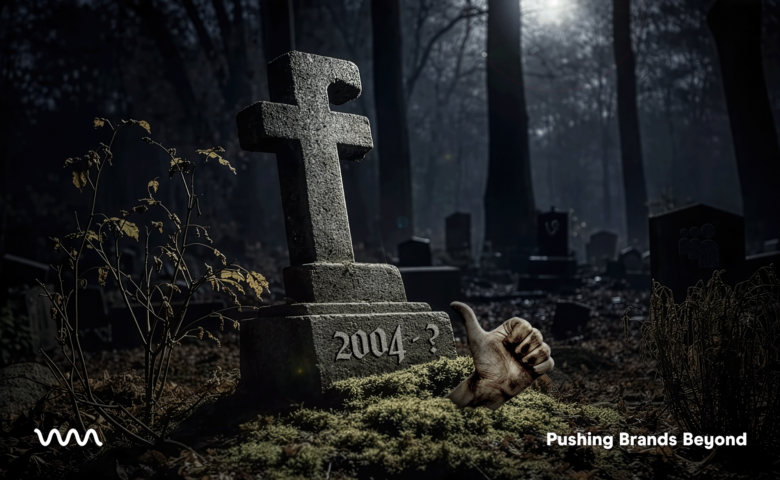
Founded in 2004 before going global in 2006, Facebook was seen as the everything app of social media where people connect, share updates, plan events, message friends, “poke” each other, and build digital communities.
For many, like myself, Facebook was our “first digital footprint”. I counted down to the second I turned thirteen so I could finally create a profile. I marvelled at the world in front of me, especially my year’s Facebook group where fellow classmates shared notes and asked for answers to the weekly homework.
Back then, Facebook felt like *the* social media. The whole world was suddenly at our fingertips, and all things digital were exciting, new, and fun. Of course, we would overshare: who wouldn’t?
@tim.collins WHO LET ME HAVE THE INTERNET????#oldfacebookposts #millenialsoftiktok #emophase #aussiethrowback #passionpop #facebook #australia #comedy #fyp ♬ original sound – tim collins
Then the social media ecosystem exploded. New competitors emerged, each catering to specific content, behaviours, and niches. Audiences were becoming more fragmented, and Facebook lost its dominance.
At the same time, the platform faced a highly publicised controversy that left users feeling betrayed. Since then, Meta and regulators implemented a range of measures to ensure user safety, but unfortunately, the reputational damage lingers.
With users opting to post more on other platforms instead, Facebook soon became less populated with connections and more with clutter. Meta’s own reporting shows the percentage of time users spend viewing content from friends declined from 22% in 2023 to 17% in 2025.
So maybe it isn’t that Facebook is dead, it’s more that it’s changed—stabilised, even.
Trends come and go, (some) platforms endure.
Social media trends move fast. Shiny new platforms capture our attention, until they don’t. Look at BeReal, whose user base more than halved after its peak. From them, we can learn that virality doesn’t always equal longevity.
Facebook is no longer “cool” or “trendy”, nor the “shiny new thing” that we hyperfixate on. Instead, it’s functional: it permeates our digital presence, the walk before our run, and is the very foundation of our online communities.
Ultimately, there is an unspoken understanding that Facebook is less about trends and more about building community through shared interests, hot topics, new opinions, local conversations, and a series of subcultures existing just within the ‘groups’ tab.
So no, Facebook isn’t dead, it’s just evolved. And just like our thirteen-year-old selves with our One Direction posters and fan fiction accounts, maybe it’s grown up for the better.
@ei55olfFashion is a cyclical, so why can’t social media be too.♬ Eple – Röyksopp
If you’re deciding which platforms deserve your attention or looking to build stronger communities online, we’d love to help. Get in touch with our team today.